Turn Strategy Into a Way of Working That Can Actually Operate
Design the roles, processes, decision rights, governance and enabling technology needed to move from strategic intent to repeatable execution.
The Strategy May Be Clear. The Operating Reality Often Is Not.
Transformation breaks down when the organisation has decided what it wants to achieve but has not redesigned how work, decisions, accountability and technology need to operate around that change.
Ownership Is Unclear
Responsibilities overlap, accountability is fragmented and work moves between teams without clear end to end ownership.
Processes Have Grown Around Problems
Manual workarounds, duplicated activity and historical controls remain even when the original reason for them has changed.
Decision Making Slows Delivery
Teams know what needs to happen but authority, approval routes and escalation points are not clear enough to keep work moving.
Technology Is Added Without Redesigning the Work
New platforms or automation are introduced into existing processes without addressing the operating model around them.
The organisation needs to know how work, accountability, decisions, controls and technology operate together.
The Components Needed to Make the Model Work
We look beyond individual processes to understand how the wider organisation needs to operate around the intended outcome.
Roles & Accountability
Define who owns outcomes, activities, controls and decisions across the operating lifecycle.
Processes & Workflows
Redesign how work moves across teams, systems, handoffs, approvals and exceptions.
Decision Rights
Clarify where authority sits, what requires approval and how decisions move through the organisation.
Governance & Controls
Build proportionate oversight, evidence, escalation and accountability into normal operations.
Information & Measures
Determine what information is required to manage performance, risk and operational decisions.
Technology Enablement
Align systems, automation and AI with the operating process rather than allowing technology to define it by default.
Design From the Operating Problem Outwards
We start with how the organisation currently works, where friction occurs and what the target outcome requires before deciding what should change.
Diagnose
Understand the current operating reality and root causes.
Map
Expose workflows, handoffs, decisions, controls and dependencies.
Design
Define the target roles, processes and operating mechanisms.
Govern
Embed accountability, controls, evidence and decision rights.
Enable
Align technology and automation with the redesigned operation.
Embed
Support transition, adoption and movement into normal operations.
The Questions an Operating Model Needs to Answer
Who Owns the Outcome?
Accountability needs to remain clear across functions, processes and technology boundaries.
How Should the Work Flow?
Activities, handoffs, exceptions and approvals need to form a coherent end to end process.
Who Can Make Which Decisions?
Authority needs to sit close enough to the work while retaining appropriate governance and oversight.
Where Are Controls Required?
Risk, evidence, assurance and escalation should be designed into the process at the points where they matter.
What Should Technology Enable?
Systems and automation should remove friction or strengthen control without obscuring accountability.
How Will We Know It Is Working?
Performance measures should show whether the new model is improving outcomes, not simply whether the process is being followed.
Where MABY Can Support
Target Operating Model Design
Define how people, process, governance, information and technology need to operate around the target outcome.
Process Discovery & Redesign
Diagnose current workflows and redesign activities, handoffs, approvals and exceptions.
Roles, RACI & Decision Rights
Establish accountability and authority across functions and operating processes.
Governance & Control Design
Embed proportionate oversight, evidence requirements and escalation into operational workflows.
Technology Enabled Process Change
Align platforms, automation and AI with redesigned business processes and accountability.
Service & Workflow Design
Structure end to end delivery around users, outcomes, ownership and operational handoffs.
Implementation & Transition
Translate the target design into practical implementation, ownership and transition activity.
Operating Model Assurance
Test whether the model is working as intended and identify gaps between design and operating reality.
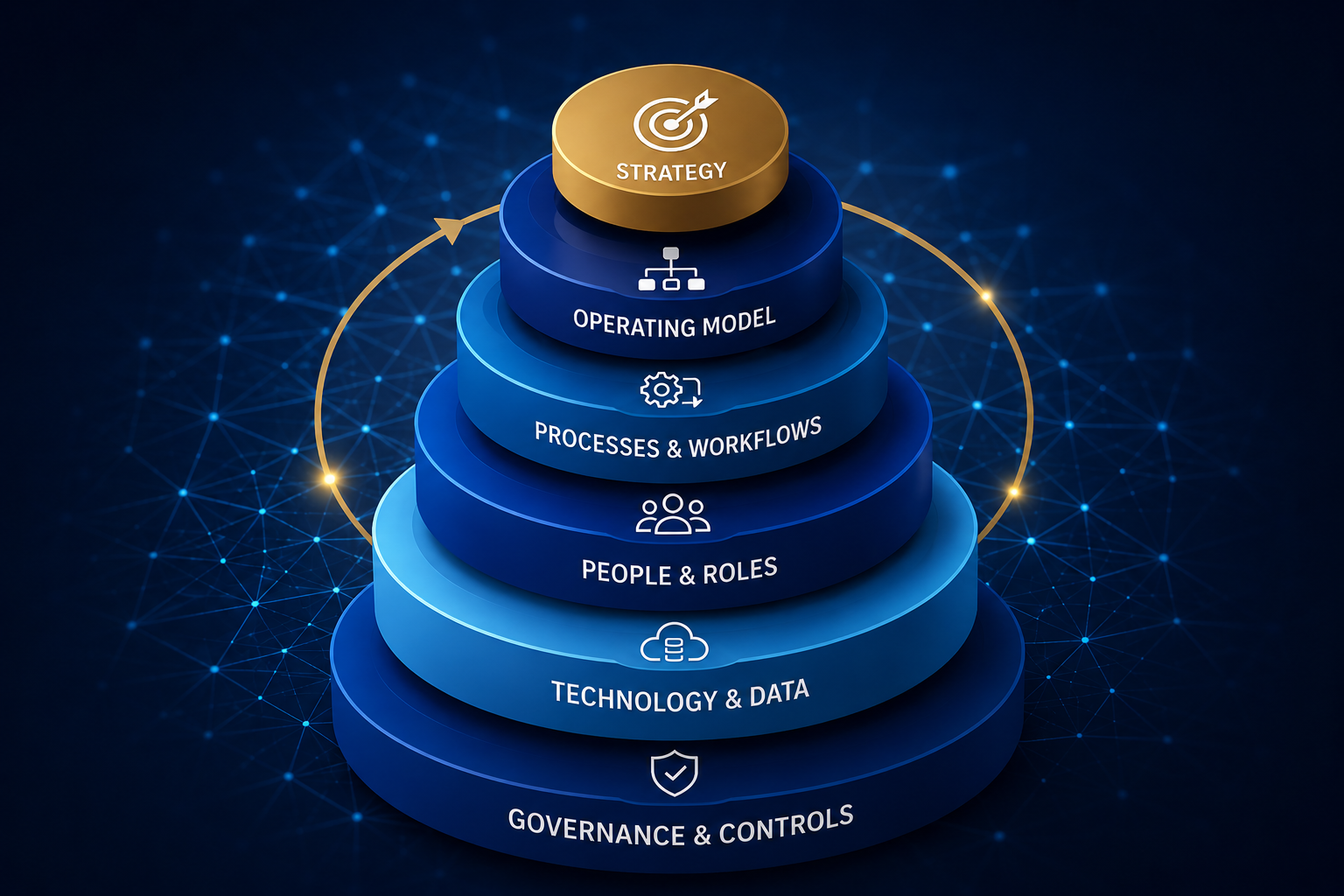
Business Orchestration & Operating Model Transformatio
See how MABY redesigned fragmented workflows, roles, decision rights, controls and technology into a connected operating model, creating a clearer route from business intent to controlled execution.
View Case Study →Operating Model Design Grounded in How Change Gets Delivered
Our perspective combines business analysis, transformation delivery, governance, quality, process design and technology. This allows us to look at both the model on paper and what will be required to make it work.
End to End Thinking
We examine how work moves across organisational boundaries rather than optimising isolated activities.
Governance Built In
Accountability, decision rights and controls form part of the model rather than being added afterwards.
Technology in Context
Technology is treated as an enabler of the operating model, not a substitute for organisational design.
Implementation Focus
The target state is considered alongside the practical path required to move the organisation towards it.
Does Your Operating Model Still Match How the Organisation Needs to Work?
Talk to us about where ownership, processes, decision making, governance or technology are creating friction and what needs to change to create a more workable operating model.
Discuss Your Operating Model →